
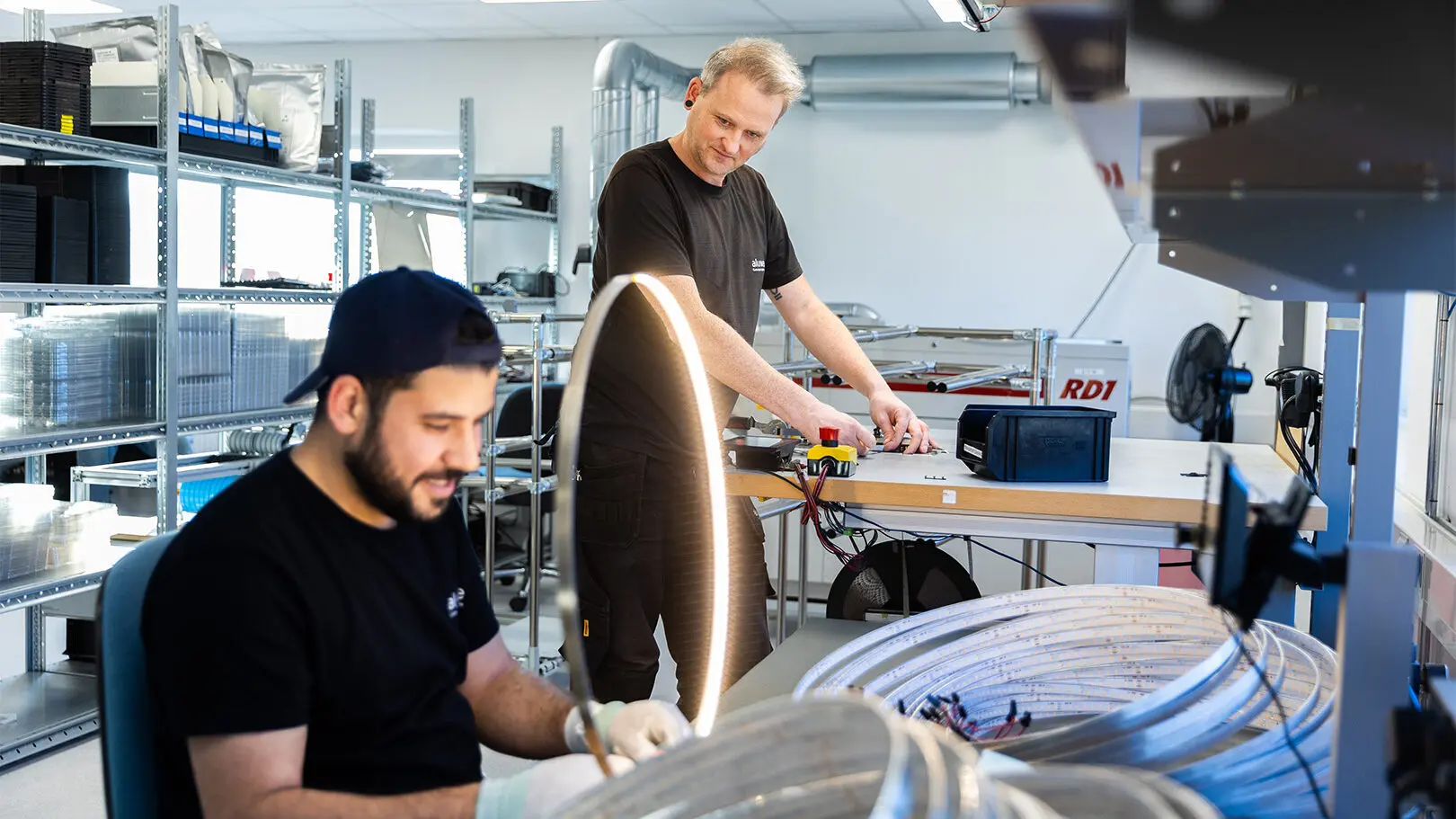
Transport disruptions, geopolitical uncertainty, tariffs and sudden shifts in demand can quickly change the conditions for production and sourcing. For Aluwave, the answer is flexibility. With fully owned manufacturing facilities in Sweden, Norway and China, the group can combine local proximity with global capacity, and adapt production according to the needs of each project. We call it Supply Chain Power.
One supply chain. Three manufacturing locations.
Aluwave’s three production sites each bring different strengths.
Landvetter, Sweden offers flexible manufacturing close to the European market, particularly suited smaller scale urgent luminaire manufacturing, or customised lighting components for the Nordics.
Qingdao, China provides capacity and scale for larger volumes and cost-efficient production for the global market.
Kirkenes, Norway specialises in production for explosion-protected components and demanding Ex applications, as well as electronics rated for aircraft applications.
Together, the sites create more than production capacity. They create options.
– The value is not simply that we have production in three countries. It is that those sites give us different capabilities and more ways to respond to what a customer actually needs. The right setup for one product, volume or market is not necessarily the right setup for another, says Bård Gamnes, CEO at Aluwave.
Flexibility when conditions change
A project may begin with smaller volumes in Europe and later require large-scale production and global distribution. Another may benefit from manufacturing closer to its end market. A specialised Ex product may require the competence concentrated in Norway, but also sub-components made in larger scales.
The most suitable production setup can also change over time, or abruptly due to external forces, such as trade wars, actual wars, climate change, political tensions. That is why supply-chain resilience is not only about making today’s production as efficient as possible. It is also about maintaining the ability to adjust when customer requirements, volumes or external conditions change.
– You cannot build a supply chain around the assumption that the world will remain exactly as it is today. Markets change, demand changes and external conditions change. What you can do is build enough flexibility into your organisation to have alternatives when they do, says Kent Johansson, COO in Aluwave AB.
Global capacity. Local agility.
The question is often framed as local versus global manufacturing. For Aluwave, it is not an either-or decision. Local production can provide speed, proximity and flexibility. Global manufacturing can offer scale, sourcing advantages and competitive economics. The strength lies in being able to combine both.
Aluwave’s operations cover product development, manufacturing, quality control and logistics, supporting everything from components and semi-manufactured assemblies to complete products. This means that manufacturing location can become part of the optimisation of a project, rather than a fixed decision made at the beginning.
– For us, global manufacturing and local production are not opposites. They are different tools. The important thing is being able to use the right one for the product, the volume and the customer situation, says Kent Johansson.
Looking beyond unit cost
Purchase price matters, but it is only one part of the equation. Lead times, logistics, quality, production capacity, responsiveness and the consequences of disruption all affect the real cost of a supply chain.
This is particularly important in OEM and ODM projects, where manufacturing strategy is closely connected to the product itself. A solution that looks cheapest on paper may not be the most competitive once logistics, lead time or production risk are taken into account. Having production capabilities in multiple regions gives Aluwave more ways to balance those factors over the lifetime of a product.
Supply Chain Power means being ready to adapt
No supply chain is immune to trade disputes, transport disruption or market uncertainty. But a flexible production structure can create more room to act.
– Our Supply Power is about combining efficiency with adaptability. We want to optimise for the situation our customers are in today, without locking ourselves into a structure that makes it difficult to respond tomorrow, says Bård Gamnes.